
News, Shark Conservation Chronicles
Hammerhead Sharks: The strange and spectacular icons of the sea

With their unmistakable T-shaped heads and piercing eyes that seem to scan in stereo, hammerhead sharks are among the most iconic — and misunderstood — predators in the ocean. Equally fascinating and formidable, these sharks captivate divers, scientists, and nature lovers alike.
Meet the Hammerheads
There isn’t just one type of hammerhead — there are nine species in the Sphyrnidae family, ranging from the smaller bonnethead (Sphyrna tiburo) to the massive great hammerhead (Sphyrna mokarran), which can grow over 6 meters (20 feet) long. 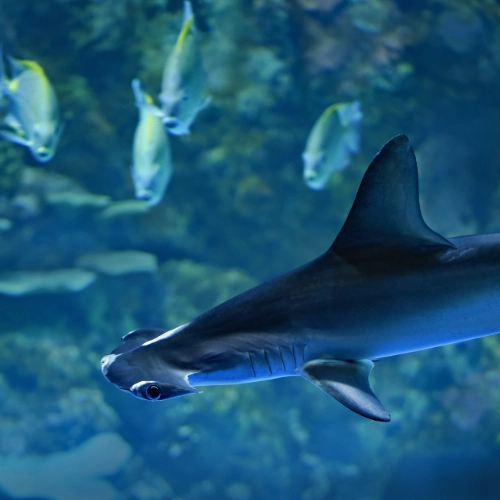
All species share a defining trait: the flattened, hammer-shaped head, or cephalofoil. Though it may look like a bizarre evolutionary accident, this distinctive feature is actually a powerful survival tool.
Why the Hammerhead Head?
The hammer-shaped head isn’t just for looks. It provides several evolutionary advantages:
- Enhanced Sensory Perception: Hammerheads have specialized pores (called ampullae of Lorenzini) on their heads that detect the electric fields emitted by prey, even when buried under sand.
- Wider Field of Vision: With eyes positioned on the far ends of their heads, hammerheads enjoy nearly 360-degree vision — crucial for spotting both prey and predators.
- Superior Maneuverability: The cephalofoil acts like a wing or rudder, giving them exceptional agility to make tight turns — ideal for hunting in complex environments like coral reefs.
Where to Find Them
Hammerheads are cosmopolitan, found in warm and temperate oceans around the world. Some of the best places to encounter them include:
- Cocos Island, Costa Rica (massive schools of scalloped hammerheads)
- Galápagos Islands, Ecuador
- Protea Banks & Aliwal Shoal, South Africa
- Bimini, Bahamas (especially for great hammerheads)
- Malpelo Island, Colombia
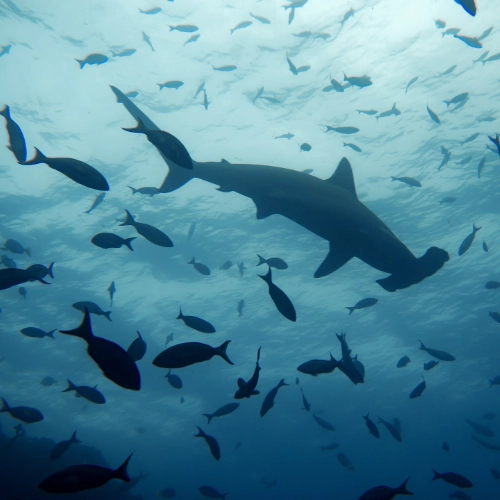
These sharks are often seen in large schools, especially the scalloped hammerhead (Sphyrna lewini), making for one of the most surreal underwater sights imaginable — walls of hammerheads moving in unison, ghostlike and graceful.
 Diet & Behavior
Hammerheads are carnivorous, feeding on:
- Bony fish
- Squid
- Stingrays (a favorite of the great hammerhead, which flips them over to deliver a lethal bite)
- Crustaceans
They’re solitary hunters by night and often schooling by day — an unusual behavior among sharks. Schooling is believed to serve multiple functions: mating, navigation, and protection.
Conservation Concerns
Despite their power and mystique, hammerhead sharks are in serious trouble. Due to overfishing — particularly for their large, valuable fins — many species are now critically endangered.
- Great hammerhead: Critically Endangered (IUCN)
- Scalloped hammerhead: Critically Endangered (IUCN)
- Smooth hammerhead: Vulnerable
Shark finning, bycatch in longline fisheries, and habitat destruction are the primary threats. Their slow reproductive rates — with long gestation periods and relatively few pups — make population recovery difficult.
Diving with Hammerheads
Encountering hammerhead sharks in the wild is a surreal and often spiritual experience for divers. These animals exhibit an almost alien grace — gliding silently, curious but cautious, commanding the water with their presence.
Tips for divers:
- Be patient: Hammerheads can be shy and will often keep their distance.
- Stay calm: Sudden movements can spook them.
- Use a reef hook (where permitted): To stay stationary in strong currents, especially at sites like Cocos or Galápagos.
- Avoid strobes and loud noises if photographing — they’re sensitive to both.
Why Hammerheads Matter

As apex predators, hammerheads help maintain the balance of marine ecosystems by controlling the population of their prey. Their decline has cascading effects, potentially leading to ecosystem collapse in some regions.
But beyond science, hammerheads represent something deeper: the mysterious, awe-inspiring beauty of the ocean. Their strange form challenges our sense of what is “normal” in nature — and reminds us that evolution rewards what works, no matter how unconventional it may seem.
Final Thoughts
Hammerhead sharks are proof that nature doesn’t just favor strength — it celebrates innovation. Their distinctive shape, schooling behavior, and intelligence set them apart as some of the ocean’s most fascinating residents.
To swim with hammerheads is to witness a masterpiece of evolution in motion. To protect them is to defend the richness of life beneath the waves.
Let’s ensure that future generations will still have the chance to be amazed — by the hammerhead’s shadow slipping silently through the sea.